
If you’re into relationship astrology, the Darakaraka is one of those placements you do not want to skip.
Most people approach love astrology by looking at compatibility, Venus, Mars, or the 7th house. And yes, those absolutely matter. But the Darakaraka adds something deeper. It points to the spouse significator in Vedic astrology, and more importantly, it helps explain why certain intimate relationships become so life-changing.
That is what makes the Darakaraka (DK) so fascinating. It does not just describe a partner. It also reveals the kind of bond your soul is seeking in this lifetime, the transformations intimate partnership can trigger, and the lessons that unfold through commitment.
In this article, we’ll cover what the Darakaraka is, how to find it, how to interpret its house placement, and what the DK in all 12 houses can say about the way relationships alter your path.
If you want to calculate your own placement first, you can use this free birth chart tool.
Table of Contents
- What Is the Darakaraka?
- How to Find Your Spouse Planet
- Darakaraka in the 1st House
- Darakaraka in the 2nd House
- Darakaraka in the 3rd House
- Darakaraka in the 4th House
- Darakaraka in the 5th House
- Darakaraka in the 6th House
- Darakaraka in the 7th House
- Darakaraka in the 8th House
- Darakaraka in the 9th House
- Darakaraka in the 10th House
- Darakaraka in the 11th House
- Darakaraka in the 12th House
- How to Work With Your Darakaraka Placement
- Final Thoughts on Darakaraka
What Is Darakaraka?
In Jaimini astrology, the Darakaraka is the significator of the spouse or committed partner. It points toward the kind of person who supports your soul’s growth through intimate partnership.
This is not just about surface-level compatibility. The DK speaks to the deeper evolutionary role of relationships: who you are meant to join with, what that bond awakens in you, and how love redirects your development.
In practical terms, the Darakaraka can describe the nature of a long-term partner. On a deeper level, it can show the psychological and spiritual curriculum that comes through intimacy.
That’s why the Darakaraka often feels so uncannily accurate. It can show both the person and the purpose.
How to Find Your Spouse Planet
The good news? Finding your Darakaraka is surprisingly simple.
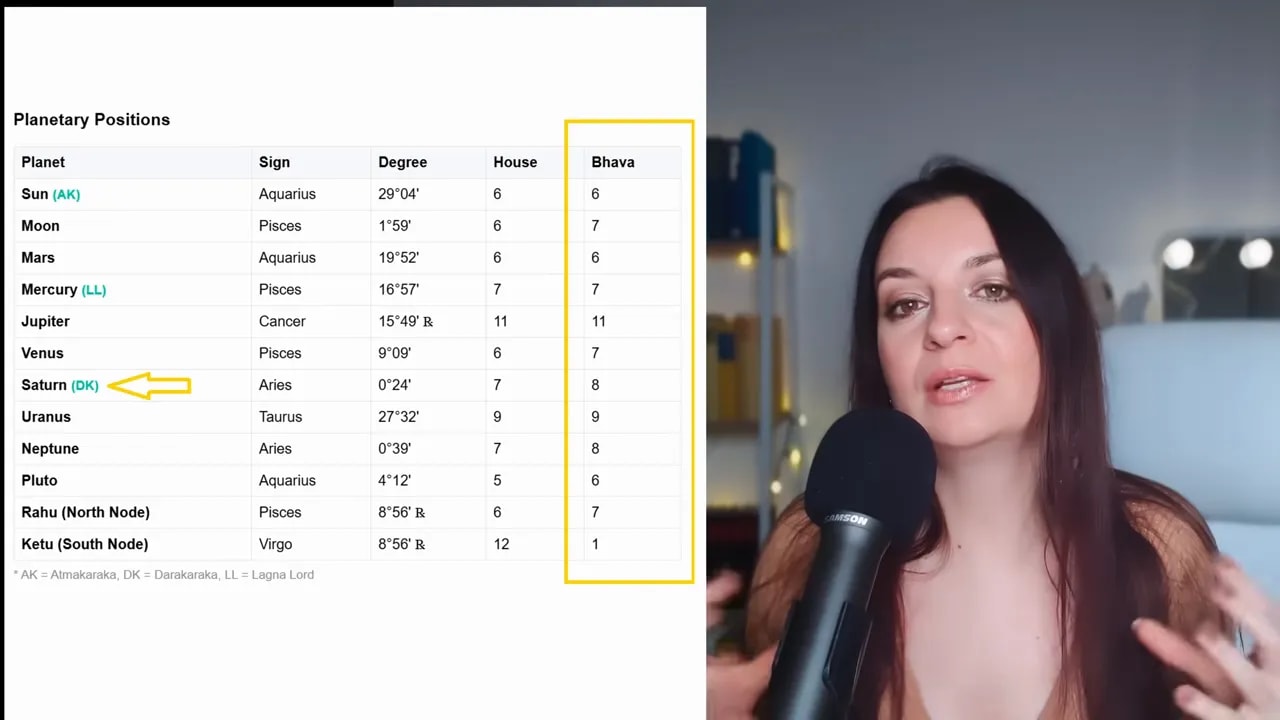
- Look at the seven traditional planets used in Vedic astrology: Sun, Moon, Mars, Mercury, Venus, Jupiter, and Saturn.
- Compare their exact degrees in your chart.
- Your Spouse Planet is the planet with the lowest degree.
Once you know which planet is your Darakaraka, the next step is to check which house it falls in. That house gives major clues about how relationships transforms your life and what themes your soul is trying to experience through partnership.
You can also just generate a free birth chart with my Birth Chart Calculator, where you can easily see which planet is your DK – and check which Bhava (the sign placement counted from the Rising Sign) it falls in.
Before You Interpret the Darakaraka, Keep This One Thing in Mind
Astrology works through symbols, and symbols can express themselves on different levels.
So if your Darakaraka lands in a certain house, that placement can show up literally, psychologically, spiritually, or through a mix of all three.
For example, a 12th-house Spouse Planet could point to a partner from abroad or a relationship connected to foreign lands. But it could also show a partnership that teaches surrender, compassion, sacrifice, charity, or spiritual release.
Both meanings can be true.
That is the best way to approach the Darakaraka: not as a rigid prediction machine, but as an archetypal map of growth.
Other Relationship Factors Still Matter
The Darakaraka is powerful, but it is not the only relationship indicator in a chart.
For a fuller picture, astrologers also examine:
- the 7th house,
- the ruler of the 7th house,
- Mars in a woman’s chart,
- Venus in a man’s chart,
- and sometimes Jupiter in a woman’s chart depending on the tradition being used.
What makes the Darakaraka special is that it often describes partnerships on a soul level. It can point to the kind of bond that not only changes your circumstances, but also changes you.
Darakaraka in the 1st House
If your Spouse Planet is in the 1st house, relationships are not a side story in your life. They are a major turning point.
The 1st house governs the body, identity, vitality, appearance, and the overall direction of life because it begins with the ascendant. So when the Darakaraka lands here, a significant partner tends to affect nearly everything.
This placement often shows a dramatic before-and-after effect. Once a major relationship enters your life, your path may shift in a very visible and undeniable way.
That transformation can take many forms:
- a complete identity reset,
- a new life direction,
- changes to health, lifestyle, or appearance,
- a move to a new city or country,
- a different social environment,
- or a change in career made possible through support, stability, or shared resources.
Sometimes the partner inspires a healthier way of living. Sometimes they help you present yourself differently. Sometimes their love gives you enough safety to finally express a more authentic version of yourself.
And sometimes the change is enormous: a completely different profession, a relocation, or a total life redesign.
With your Darakaraka in the 1st house, intimate partnership tends to become part of your identity story. The partnership does not merely accompany your life. It alters your trajectory.
There is often a sense that your soul is meant to experience partnership as a catalyst for becoming more fully yourself.
Darakaraka in the 2nd House
If your Spouse Planet falls in the 2nd house, relationships strongly shape your values, stability, and sense of what truly matters.
The 2nd house is linked with family, speech, resources, accumulated wealth, food, self-worth, and the systems of value that support daily life. So this placement often shows a partnership that changes your material reality and your internal priorities at the same time.
A significant partnership may affect:
- your finances or standard of living,
- your relationship to money and security,
- your family life or family responsibilities,
- the way you speak and communicate,
- and your sense of self-worth.
Sometimes this looks very concrete. Marriage may bring you into a different financial environment, a new family structure, or a lifestyle with stronger foundations. In other cases, the relationship teaches you what real security is and helps you become more grounded, more responsible, and more discerning about what you truly value.
The DK in the 2nd house can also indicate that partnership teaches lessons around nourishment. That could be literal, through food and home-building, or symbolic, through emotional support and stable presence.
The deeper lesson here is often about building a life that lasts. Love becomes the place where values are tested, refined, and rooted.
Darakaraka in the 3rd House
With your Spouse Planet in the 3rd house, partnerships becomes a training ground for courage, expression, and initiative.
The 3rd house rules communication, skills, effort, self-expression, curiosity, courage, short-distance movement, and the way we act on our own will. So this placement often points to a partner or relationship dynamic that pushes you to speak up, take risks, and use your voice more boldly.
This can show up as:
- a partner who encourages you to write, speak, create, or teach,
- a relationship that strengthens your confidence,
- a bond that requires more direct communication,
- or a connection that helps you become more independent and proactive.
Sometimes the partner is highly communicative, skillful, entrepreneurial, or mentally active. Sometimes the relationship itself teaches you how to stop shrinking and start expressing what you really think and feel.
The Darakaraka in the 3rd house can also bring lessons around consistency and effort. Love may not feel passive here. It may require conscious communication, mutual initiative, and real work to build trust and alignment.
The soul lesson is often about developing strength through interaction. Partnerships teach you how to engage life more bravely.
Darakaraka in the 4th House
If your DK is in the 4th house, relationships touch the deepest interior layers of your emotional life.
The 4th house is associated with home, roots, emotional security, mothering energy, private life, the inner heart, and the feeling of belonging somewhere. So when the Darakaraka lands here, intimate partnership often becomes deeply tied to emotional healing and the search for home.
This placement can indicate:
- a partner who feels profoundly familiar,
- a relationship centered around home-building,
- a move into domestic life, property, or family concerns,
- or a bond that brings unresolved emotional patterns to the surface.
Sometimes the partnership gives you the home you always wanted. Sometimes it exposes where your foundations were never truly secure, so that you can rebuild them on more honest terms.
Darakaraka in the 4th house often carries a strong emotional imprint. The partner may stir tenderness, vulnerability, nostalgia, and a powerful need for closeness. But it can also bring lessons around emotional maturity, caretaking, and the difference between comfort and true safety.
The soul craves a relationship that reaches the heart here. Love becomes a place of rooting, healing, and inner settlement.
Darakaraka in the 5th House
The Spouse Planet in the 5th house brings relationships into the realm of romance, joy, creativity, and heartfelt self-expression.
The 5th house rules love affairs, pleasure, creativity, children, inspiration, performance, and the ability to radiate from the heart. So a major partnership with this placement often awakens your capacity for joy and creative aliveness.
This can look like:
- a highly romantic or passionate bond,
- a partnership that reignites your creativity,
- a partner connected to art, performance, teaching, or children,
- or a relationship that teaches you to open your heart more freely.
There is often a playful, expressive, or dramatic quality to the love story. But the deeper lesson is not just about romance. It is about learning how to create from the heart, how to enjoy life more fully, and how to share your inner light without fear.
For some, Darakaraka in the 5th house also ties partnership to children or the desire to create something lasting together, whether that means a family, art, business, or a meaningful legacy.
The soul lesson here is about heart-centered expression. Partnerships helps awaken delight, passion, and the courage to live more vividly.
Darakaraka in the 6th House
DK in the 6th house is one of the placements that can feel the most demanding, but also deeply transformative.
The 6th house rules service, work, health, daily routines, responsibility, conflict, effort, and the areas of life where growth often comes through friction. So with this placement, partnership may bring lessons through challenge, adjustment, and practical reality.
This does not automatically mean a bad relationship. It means the relationship is likely to teach through refinement.
Possible manifestations include:
- a partnership that changes your routines and habits,
- a partner who helps you become healthier or more disciplined,
- lessons around service, humility, and daily effort,
- or a bond that forces you to work through conflict in a more conscious way.
Sometimes this placement brings a relationship that asks for maturity in ordinary life, not just in grand emotional moments. Can you support one another consistently? Can you handle practical burdens together? Can you improve rather than resent what needs work?
The Spouse Planet in the 6th house can also reveal karmic entanglements where love teaches discernment, boundaries, and responsibility. The soul may be learning how to build a union through conscious labor rather than fantasy.
The deeper gift is strength. Partnership becomes the place where character is sharpened.
Darakaraka in the 7th House
This is a very strong placement for partnership themes because the 7th house naturally rules marriage, committed partnerships, and one-to-one bonds.
When your Spouse Planet is in the 7th house, the life path is often deeply intertwined with intimate partnership. Relationships become one of the most central arenas of destiny.
This placement can indicate:
- a strong desire for committed union,
- a major life focus on partnership,
- a spouse who strongly embodies union itself,
- or repeated lessons around balance, compromise, projection, and mutuality.
The relationship often functions like a mirror. Through the partner, you see yourself more clearly. That can be beautiful, confronting, or both.
The Darakaraka in the 7th house often intensifies the importance of choosing wisely. Because partnership matters so much here, the right pairing can be profoundly aligning, while the wrong one can become a major detour or source of imbalance.
The soul lesson tends to revolve around learning true partnership: not dependency, not control, but mutuality.
Darakaraka in the 8th House
Your Spouse Planet in the 8th house points to relationships as a force of deep transformation, crisis, intimacy, and rebirth.
The 8th house governs shared resources, hidden truths, vulnerability, psychological depth, death-and-rebirth processes, trauma, trust, and the mysteries that strip away the superficial layers of self. So this placement is rarely light.
It often describes a bond that changes you from the inside out.
This can manifest as:
- intense emotional or sexual bonding,
- a relationship that brings buried fears to the surface,
- shared financial or karmic entanglements,
- or a partnership that leads to profound psychological healing and transformation.
With the Darakaraka in the 8th house, intimacy is not casual on a soul level. The union may require surrender, honesty, trust, and the willingness to go into uncomfortable emotional territory.
Sometimes this placement brings powerful karmic bonds that force you to confront attachment, control, betrayal, vulnerability, or fear of loss. But that confrontation can be exactly what opens the door to deep healing.
The soul lesson here is metamorphosis. Love becomes the crucible that reveals what must die so something truer can be born.
Darakaraka in the 9th House
With the Spouse Planet falling in the 9th house, the relationship becomes a path of meaning, belief, expansion, and spiritual or philosophical growth.
The 9th house rules higher wisdom, faith, pilgrimage, long-distance travel, teachers, worldview, and the search for truth. So this placement often indicates a partner who broadens your mind and reorients your beliefs.
This may show up through:
- a partner from a different culture or background,
- a partnership connected to travel or foreign places,
- a bond that deepens your spirituality or philosophy,
- or a partner who acts as a guide, teacher, or source of perspective.
The relationship may open doors you would never have walked through alone. It can expand your vision of life and push you beyond the limitations of your old worldview.
Darakaraka in the 9th house often carries a sense that partnership has a fated, guiding, or meaning-making quality. Love becomes a vehicle for wisdom.
Darakaraka in the 10th House
The Spouse Planet being in the 10th house brings relationships into the arena of vocation, public life, status, and worldly direction.
The 10th house rules career, legacy, ambition, responsibility, reputation, and visible achievement. So this placement often indicates that a major partnership will have a direct effect on your public path or life purpose.
This can manifest as:
- a partner who influences your career,
- a pairing that changes your ambitions,
- a spouse who is highly visible, driven, or accomplished,
- or a bond that pushes you toward greater responsibility and maturity.
Sometimes the partner helps you step into your calling. Sometimes the relationship alters your priorities around success and legacy. Sometimes it places you in a new social role that requires public growth.
With the Darakaraka in the 10th house, love and destiny often meet in the visible world. This is not always private, soft, or hidden. It may have consequences for your mission, your image, and the work you are here to do.
The soul lesson is often about aligning partnerships with purpose. Intimacy becomes part of your contribution to the world.
Darakaraka in the 11th House
If your DK is in the 11th house, relationships tend to influence your future vision, goals, networks, and long-term hopes.
The 11th house rules community, friendships, social circles, gains, aspirations, and the larger future you are trying to build. So this placement often points to a partner who changes what you want from life or helps you reach toward a bigger horizon.
This can look like:
- a relationship that begins through friendship or community,
- a partner who expands your network,
- greater gains or opportunities through partnership,
- or a bond that helps you dream bigger about your future.
Spouse Planet in the 11th house can also show that partnership teaches the difference between desire and fulfillment. Sometimes what you think you want evolves dramatically once the right partner arrives.
The spouse may become an ally in your long-range goals, or the relationship may help you understand which ambitions are truly aligned and which were borrowed from social pressure.
The soul lesson here often revolves around vision, belonging, and future-building. Love helps you imagine a larger life.
Darakaraka in the 12th House
Spouse Planet in the 12th house is one of the most spiritual and layered placements of all.
The 12th house rules endings, surrender, solitude, foreign lands, sleep, the unconscious, losses, liberation, compassion, sacrifice, and transcendence. So when the Darakaraka falls here, relationships may carry an otherworldly, karmic, or deeply healing quality.
This placement can manifest very literally as:
- a foreign spouse,
- a partnership tied to living abroad,
- distance, retreat, or isolation,
- or a bond that unfolds in unusual or hidden circumstances.
But it can also show up psychologically and spiritually.
A 12th-house Darakaraka relationship may teach:
- compassion,
- selflessness,
- ego-release,
- forgiveness,
- charity,
- or surrender to something larger than personal control.
This kind of union may dissolve old identities. It may ask you to let go of rigid expectations. It can feel deeply fated, deeply healing, or at times difficult to define in neat worldly terms.
The soul lesson here is often surrender. Love becomes a doorway into transcendence, humility, and spiritual growth.
How to Work With Your Darakaraka Placement
Once you know your Darakaraka house, sit with it as a symbol of growth rather than a fixed prediction.
Ask yourself:
- What area of life do my relationships seem to transform most strongly?
- What patterns keep repeating in intimate partnership?
- What kind of growth am I being pushed toward through love?
- Where is my soul asking for more maturity, trust, courage, surrender, or authenticity?
That is where the Darakaraka becomes more than a label. It becomes a lens.
Final Thoughts on the Spouse Planet
The Darakaraka can reveal far more than the personality of a spouse. It can show the function of relationships in your destiny.
Some people meet partners who change their home life. Others meet partners who transform their identity, career, worldview, healing journey, or spiritual path. That is the beauty of our Darakaraka: it reminds us that intimate partnership is not random. It carries meaning.
So if you have ever wondered why certain relationships feel so pivotal, why love seems to push you toward very specific lessons, or why one bond can split life into a “before” and an “after,” the Darakaraka is one of the clearest places to look.